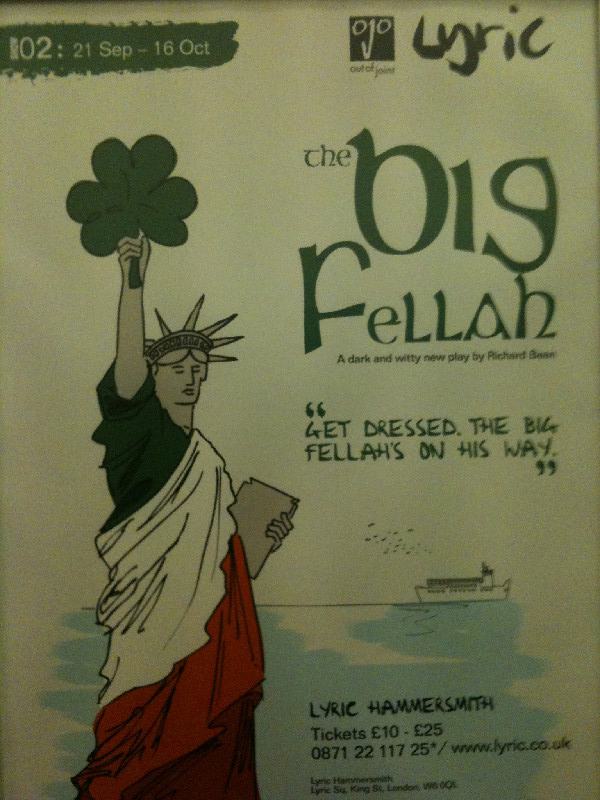
The Big Fellah – Vanity & Terror in NYC 3.5*

‘Get dressed, the Big Fellah’s coming.’

The Big Fellah@Lyric Hammersmith John Haynes, Finbar Lynch, Fred Ridgeway, Rory Keenan and David Ricardo-Pearce

Richard Bean’s dramatic play, published just this year, covers the Troubles from an Irish-American perspective using the vantage point of five men in a New York IRA safe-house from 1972 through mid-2001.  Fireman Micheal Doyle houses on the lam IRA member Ruairi O’Drisceoil and is compelled by the events of Bloody Sunday to offer his apartment and services to the struggle.  Doyle is promptly enlisted by “the big fellah” David Costello and the scene is set for a tale of American funded violence, the political minefield of cross-ocean operations and the high cost of idealism.

Bean weaves a universal story through this period specific tale.  The script, witty and informed, delivers a surprisingly accessible narrative on the American “dream”, international terrorism and humanity.  It’s a dark tale of nationalism and principles warped by vanity, self-serving power structures, the passage of time and the impact of realism.  Taking no side in the struggle other than a stance against violence Bean unfolds a viscously witty tale over three decades of tumultuous change.

The five iconic male leads transform into distinct individuals throughout the course of the performance.  The trials of family tragedy, disillusionment, loneliness and dreams abandoned or achieved evolve each into compelling three-dimensional characters.  The cast work seamlessly together and create a mighty collaborative performance; each contributing significantly to this production’s success.

Finbar Lynch as the Big Fella - Photo courtesy John Haynes

Finbar Lynch personifies the Big Fellah beautifully; power, menace, charisma and despair are all palpable. His speeches cum monologues are delivered with perfect assurance building to a powerhouse delivery in the 4th act and his Machiavellian hand in Doyle’s final initiation.

Rory Keenan portrays the demanding character of Ruairi’s with unaffected skill revealing the depths of a man who at the onset is little more than a caricature.   As Ruairi sees things it’s alright being in the IRA , “but if there’s one thing I’d change, it’s all the killing.”  Conversely, David Ricardo-Pearce deftly maintains the enigma of Doyle exemplifying the foreshadowed menace of the quiet man.

Youssef Kerkour embodies the role of corrupt bigoted New York cop Tom Billy Coyle. The simplistic unashamed prejudices of his role are magnified by this inspired casting.  Fred Ridgeway’s take on the role of Frank McArdle is delivered with tired, disillusioned, painful abandon.
A testosterone loaded production the female characters Elizabeth Ryan (Claire Rafferty) and Karelma (Stephanie Street) provide an injection of femininity to balance the production and keep it contemporary.  Both are wonderfully uninhibited yet deliver strong, intelligent and ultimately independent characters that ring true.  Rafferty’s pivotal performance is particularly resonating.

The Big Fellah delivers a powerful story of vanity, allegiances and betrayal. Guaranteed to entertain this gripping and at times oddly humorous production leaves a dark emotional chill as the curtain falls.

Lyric Hammersmith
Lyric Square King Street
London, UK, W6 OQL
21 September-16th October 2010

Posted in Art, Theatre | Leave a comment

Bubba & Luvvie @ The King’s Head – Not so Lovely 1.5*

Bubba and Luvvie is the tale of a man and a woman who meet on an ocean cliff top on the eve of a court case in which they are both pivotal players: the former is the accused, the latter the key witness. Throughout the 90 minute play a series of “stories” disclose details of the characters, the case and their relationship.

The key to this play should be the electricity and dynamic between the two performers and yet despite their best attempts there is no chemistry nor much logic to the drama as it unfolds.

The staging is sparse; only the actors – Mia Soteriou (Luvvie) and Gerard Mc Dermott (Bubba) – a park bench, the intermittent sound of waves and sporadic projections entertain. The dénouement exposes an extensive and intense relationship yet the dialogue illustrates none of this intimacy.  In fact during the first 40 minutes the characters act as though strangers.  Any motive behind this lack of acknowledgement is further lost against the urgency both should profess to solve a “whodunit” before dawn that could potentially ruin them.  The cat and mouse game which works so well in other scripts simply doesn’t ring true leaving one dubious of any romance which might have tied this plot together. Further Luvvie is determined, to the point of recording the exchange, to resolve a loss yet as the play concludes appears to inexplicitly wipe this from her mind.

The Press Release tells us to expect the magnetism of Taylor and Burton. Sadly I don’t believe Soteriou and McDermott even had a chance to aim for that pinnacle.

Finally kudos must go to Mc Dermott and Soteriou who do their utmost to bring life to a flawed drama and on the night I attended performed in absolutely stifling conditions.

The King’s Head
115 Upper Street
London, UK, N1 1QN

Posted in Theatre, Uncategorized | Leave a comment

Lulu – An Enigmatic, Endearing and Enduring Portrayal 4*

Lulu - Sinead Matthews, images courtesy C Ashmore

Director Anna Ledwich revives Frank Wedekind’s (1864-1918) ‘debauched’ play delivering a many layered tale of desire, death and self-awareness.  The indistinct era of this staging accentuates the erotic forthrightness of a script that broke so dramatically with the moral attitude of its time and Sinead Matthew embodies a Lulu who is more damaged-goods than maverick. A femme fatale obscured by her own reflection, masked by a childlike demeanour, recoiling from womanhood and responsibility. This Lulu is a temptress devoid of self knowledge who manipulates and is victimized in equal measure by the men in her life.

The modest set offers little clarity or detail – does a roped chair indicate bondage, could a plastic sheet halt a raging man? – echoing the lack of self-awareness in the central character. That Lulu is little more than a manifestation of her lovers’ desire is aptly underscored by her consecutive renaming: Lulu, Lolly, Katya, Eve, Mignon. Musical numbers are movingly delivered by both Michael Colgan – as the hauntingly puritanical and tormented Schwartz – and Matthew further blurring any sense of period.

Lulu’s yearning to be the object of desire, her longing to have men drawn to her conflicts with her distain for physical contact. Matthew, comfortable with her own nudity, neatly portrays coquettish need alongside the subtle rejection of physicality. A shadow of jealousy crosses her face as Dr Goll – played by Paul Copely assured in both this and the debilitatingly abusive father role – her first husband, is tempted away openly betraying her fragility.  Even the subsequent deaths have an element of abandonment. The plaint of “you made me what I am” is repeated throughout and Ledwich (in the role of Countess Geschwitz on opening night) highlights the cyclical nature of abuse and blame through Lulu’s successive husbands enacting dual roles – and as each of the reincarnated actors returns their new character is more lethal than ever.

Tones of tragedy and melodrama are offset by comedic moments none more successfully delivered than those by Sean Champion as the seemingly unflappable Schoning.  Campion is magnificently enigmatic and compelling in the powerful role of puppet master, object of desire, father-figure, junky and mad-man.  He carries the weight and significance of his Machiavellian role easily.  Magnanimously and devilishly he delivers comedic and cruel dialogue whether the importance of appearing as “Nelson’s Column or something equally erect” or an attempt to engender reconciliation “No one would guess that she was a slut”.

The clichés of Lulu’s downward spiral disappoint and the final shift from enigmatic characters of great urgency and unpredictability to melodramatic truism concludes an otherwise fine production.  Ledwich has produced a complex and hazy portrait of Lulu beautifully reflecting the theatre’s most inscrutable and enduring temptress.

Gate Theatre
11 Pembridge Rd,
London, UK, W11 3HQ
0207 229 9040

Until July 10th 2010

Posted in Theatre, Uncategorized | Leave a comment

Meow Meow: This Pussycat has Claws

I’m thrilled to have seen this act without reading the publicity, forming any preconceptions and I highly recommend that you do likewise – stop reading, buy a ticket and enjoy a truly delicious performance.

Meow Meow by Karl Giant

Meow Meow in all her tatty sequined glory with dishevelled hair and palming two cigarettes storms London’s Soho Theatre Company’s “sacred space” delivering an astounding cabaret.  The simplicity of her act – her voice, her presence- is the coup de grace that makes this show so successful placing the many pretenders to this art form firmly in her shadow. Her astonishing voice is a revelation as she postures, sing, stalks, and stumbles her way through the 70-minute performance.   Her gin-soaked voice –rising to a shrill crescendo at a moment’s notice – and her infinite dramatic pauses breathe flesh and blood in to the myriad of torch songs performed.  She is a one-woman tour de force;  exuberant and mad, her femininity squarely to the forefront as she prowls the theatre toying with her audience in a manner well in keeping with her name.   Her hauntingly powerful vocals recall another era as she performs songs in flawless French, German and Italian.

Throughout the act she is physically engaged with her audience – selecting some as assistants, others as translators, yet more as furniture.  In one riotous moment she crowd surfs, legs akimbo, to the highest row afterward composing herself by draining my companion’s entire glass of wine.

Meow Meow is a paradoxical character; in complete comedic disarray yet a fully composed vocalist. Her madness can be sweet, almost pathetic, even vulnerable yet she transforms to a shrieking commandant who demands a response – a seasoned, world-weary dominatrix. She is at once scattered then singularly focused.  She is chaotic, striding over the crowd (think Roberto Benigni at the ’98 Oscars) then frozen mid-audience bathed in a single pink spotlight delivering a reworked version of Piaf’s La belle Histoire d’Amour.  She carries us on her musical journey – her voice, her pauses take us to places of sentiment and stillness.  Throughout the night she plays out a gamut of emotion from hilarity through tragedy never ever allowing her whiskers to slip.

Meow Meow is a force of nature – witness it.

Meow Meow Beyond Glamour: The Absinthe tour
19 March – 10 April 2010
Soho Theater Company
21 Dean Street
London W1D 3NE

Posted in Uncategorized | Tagged , , , , | Leave a comment

The Wages of Thin – 3.5*

The Wages of Thin

Oscar nominated Trevor Griffith’s debut is a brief single act play written in 1969 in response to the 1967 Sexual Offences Act – legislation deemed to facilitate the prosecution of gay men.  Despite gathering dust for 30 years before publication the premise remains fresh and timely in this age of spin.  Themes of privacy, respect and exploitation ring true and this black comedy will entertain while the subject matter resonates with contemporary audiences.

The set, a men’s toilet, is a perfect match for this petite theatre.  The tiny venue was tight and confined with only three L-shaped rows where those to the front had their feet literally on the set.   Dank urinals, a cracked pane of security glass in the door and a grimy exposed bulb which rattled as trains pass overhead.  The audience, cramped and confined, were in as hard and uncomfortable a situation as the scenario that played out before us.

The play centres on Alfred Rimbaud Thin (Richard Sandells) a mild mannered office worker accosted and interrogated by two feral detectives known simply as One (Ryan Gage) and Two (Alan Frances).  The investigation, purportedly in regards to a murder, soon reveals its aim to delve and expose Thin’s deepest, most private secrets: an incestuous affair, shady trips abroad and homosexuality.

The play is further offset by superb casting that augments the intensity and depth of the script. Gage and Frances form an excellent double-act as the detectives; using comedic timing they personify their characters rather than creating caricatures.  Gage is fantastically edgy alternating between a menacing Cheshire cat grin and a grimace that, as an aside, makes him a shoe-in for a Blair biopic. Frances plays the rather rambling yet unpredictable muscle with disarming deftness.  Richard Sandells delivers a precise performance astutely balancing tension, anger, fear and caution to keep Thin real and the audience riveted.

The CongoRed production is a real sensation and remarkable achievement.  The performances and questions raised about public and private personas linger well after Thin’s hour is up.

The Wages of Thin – 3.5*
The Old Red Lion Theatre
418 St. John Street
London, UK, EC1V 4NJ
0207 837 7816

Posted in Theatre, Uncategorized | Tagged , , , , | Leave a comment